Sunday, January 11, 2015

Prague II: Vysehrad

Vysehrad is an old fort on a hill that began in the 9th century.  It once had a castle and was the seat of the bohemian empire, but it was never the crown jewel of any of the great empires.  It had centuries where it was in favor, and centuries where it wasn't.   The end effect is a very unique space for wandering around.

The location on top of a mountain by the river made Vysehrad a great choice for a castle.  Visiting the site begins by walking through a gate within the massive brick fortifications.  These walls are not ancient by any means, the walls are part of upgrades relating to the time the fort was used for an Austrian army barracks during the 17th century.  

The compound contains another ring of walls within the great brick wall.  This middle area felt like a part of Central Park.
Between the walls.  There is a lot of green space and trees within the fort (hardly any buildings).  Lots of people were walking their dogs through the abandoned tunnels and along the rampart.
According to Wikipedia, this building here, the St. Martin Rotunda, is the oldest building in Prague (11th century):

I'm regretting being too cheap for the historical tour guide...

The present day fort is a product of nationalism during the 19th century when Bohemian rulers renovated the area.  

The grounds leading up to the church reminded me of Golden Eye for some reason (communism + Bond movie).


Right on the River
The Church:

The Church of St. Peter and Paul has existed in some form or another since 1070.  Unfortunately, Hussites and others destroyed different versions of it along the way.  The most recent version, the one we see today, is from the renovations brought about by the Bohemians as they beautified Vysehrad.

The current church of St. Peter and Paul was built 1885 to show off Bohemian art and neo-Gothic architectural prowess.

I really enjoyed the church.  In general, Prague was very colorful.  The church was no exception, it had beauful mosaics and paintings on nearly every surface.  It was an unusual style for a Roman Catholic Church (based on my relatively limited experiences).  Also, there were lots of explanations (in English) explaining the history and significance of the relics within the church.  I always find the circumstances and politics of 'which church gets what' very interesting.


Example description (art not shown).


Cemetery:

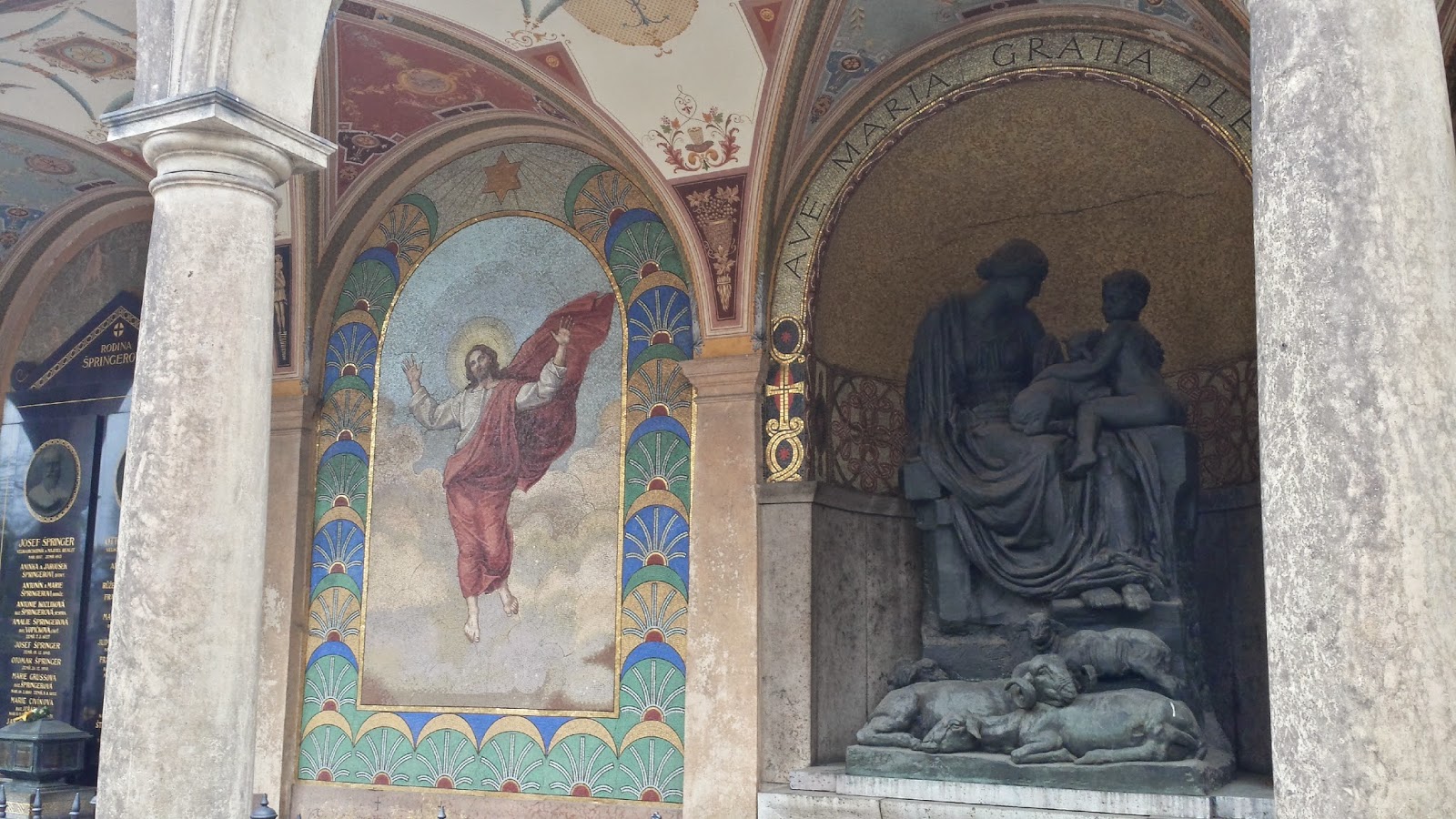
The cemetery of Vysehrad is also historic (and quite colorful).  I don't know anything about Czech politicians, but I did recognize on of the numerous 'starred' graves within the cemetery. It was of Antonín Leopold Dvořák, the composer.




Walking around as I left Vysehrad:

After the day exploring Vysehrad, I headed back to Prague to see the Christmas Market, which officially opened on the same night, as well as other buildings I wanted to see.
Dancing Building


For Dinner I ate "Pig Neck" and roasted potatoes- it was absolutely delicious:

 Prague had insane amounts of graffiti and street art:


While I was in Prague, I actually didn't know it was the opening of the Christmas market.  I was wandering around after dinner, trying to find this famous astronomical clock, when I noticed each street getting more and more crowded.  As I exited a particularly narrow street, I entered the slipstream of a mob and was whisked away to the heart of the old-town and the christmas market.
Big Crowd
At this point I still don't understand what is happening and why people are jockeying for position so aggressively within the square. And then it happened, a brass band started belting away Slavic Christmas tunes and everyone turned to stare at the silhouette of the town's Christmas tree.

After much adieu and a count-down, somebody plugged the big tree in and everyone clapped.  It was rather anti-climatic to be honest, although the tree was beautiful:


I really enjoyed Prague.  It was not crowded (apart from the lighting of the tree), had beautiful architecture, very walk-able, and very obvious that there was a lot of history within one town.  During one of the days I ended up looking out onto a square that looked very familiar.  I looked it up on the internet and realized I had taken almost the exact picture as the one my high-school textbook used when discussing the Velvet Revolution.  

Original photo from Brian Harris

Prague I

 Sorry for the month long break! Things got busy as I wrapped up my last 'class' for Auburn University.  I turned in 2.5 papers in the month of December on solar energy and received an 'A' for the class.  It didn't feel real to actually be done with official school work- so I called the registrar and they were able to confirm that I in fact graduated.

After Thanksgiving and before the craziness of December, I took a weekend trip to meet up with my buddy Alex and his friends in Prague.  They were on the last two days of a seven day long euro tour they planned to celebrate their graduation from UC Santa Clara.

Euro tour crew
 I got in at midnight on Friday and met up with them for the second half of a pub crawl.  Pub crawls in European cities often target the Hostel crowd, which is usually a thirsty group of internationals between 19 and 25 years old.  I showed up at the halfway point and the tour participants were already very jolly.  It was great to see Alex and we ended up staying up very late.

Day 1: Wandering

We decided to try and see Prag by foot- it isn't a very big city (the Altstadt at least) and the buildings and streets are very beautiful.

First we saw a new street act that blew my mind for 10 seconds longer than normal:
 

 Then we went to a Christmas Market to get delicious Czech ham, potatoes, and Cinnamon-roll-on-a-stick.  The market was only just getting set up:

Then we walked to the Castle/palace on the hill.


... But it wasn't too many kilometers before we needed a break and some water:
 

We took the advice of the bar(water)tendress and approached the castle from the 'Old Stairs':


Sometimes I'm not even sure what I'm taking a photo of but I feed off the energy around me.  I have noticed in my travels that if at least 3 tourists are taking a photo in the same direction, every other tourist will pull out their camera.  Whatever psychological condition this is needs to be named/studied soon; it has caused people to take a lot of pointless photos.


Prague Castle, according to Guiness World Records, is the largest castle in the world.  Besides the walled castle itself, part of the red-roofed village is also part of the compound.  Prague has been the seat of the Bohemia empire, Holy Roman empire (Charles IV or Rudolph II), and Austrian empire (Ferdinand I/V).

The Prague Castle has a row of houses, called the Golden Lane, that people lived in until World War II.  Apparently bathrooms and electricity never caught on, and eventually people left, were displaced by the war, or were bought out; the lane is now part of the historic castle and a period-musuem for tourism.

From 1914-1917, writer Franz Kafka lived in house No. 22:

I could see how the living conditions might of lead to his Nihilism...
If the biographies of Kafka weren't depressing enough, we ventured on into the medieval section of the castle, which focused only on warfare and torture:

Here Alex explains that a being hit with a metal ball swinging from a 4 foot long staff would most likely really hurt.
This chair was pretty self explanatory.


This was the only entrance/exit to a giant pit underneath the torture tower.  Apparently it was exclusively used as an entrance.
 We left the dark ages to head to the 19th century Austrian section of the palace/castle:

The Prague Basilica is pretty breathtaking.  It is surrounded on all sides by the administrative parts of the palace, which means you don't approach the church from a distance.  Instead, you turn a corner and BOOOOM it's right there looming over you.  It was a nice effect:


The main church of an empire definitely gets the best pick of relics and religious art.  We were blown away by some of the castings, statues, mosaics, and paintings:
 

From the church we headed to the interior of the palace.  I really enjoyed the ceilings of the thrown room and other royal meeting rooms:


If you squint or drink too many beers it looks like Alex has on the old crown and scepter.
 

At this point Alex and I realized we needed to take a picture for the Moms, so we handed my phone to one of the friends. The peanut gallery made it difficult to get a simple picture:

From the palace we headed to the John Lennon wall.  We weren't sure what to expect because just days earlier, the local art school white-washed the historic graffiti wall in an effort to give their generation a voice.  They apparently were no longer interested in the protest art related to the communist era.


And, the Lennon wall turned out to be the perfect Selfie backdrop.  People were going crazy to take new profile pictures and the like:


And if everybody else was doing it...

No shame. We aren't part of the problem- we're different.
 

From the wall we went over the historic bridge and back into the city.  The bridge is most famous for being the bridge that Vin Diesel jumps off or blows something up in the critically acclaimed film "XXX" (triple X). Others argue it is more famous for its history, impressive gate, and strategic importance to the castle and trade within the region.

Alex rubs some luck from the statue.
Alex barely resists the urge to buy the Mel Gibson drawing he's been waiting his whole life for.
 We took a group photo: 
 

And then walked around some more.

We spent the rest of the day exploring and visiting Czech watering holes.  The cost of beer and the quality of the food made for a wonderful combination.  Early the next morning Alex and his friends left to head back home. I stayed the day and explored more.

Sunday, December 7, 2014

Vorsprung Durch Technik

Vorsprung Durch Technik is the official slogan of Audi. It means, "advancement through technology."  In Germany, it is critical to harness this intellectual ideal, especially during lunch:


It was a good sandwich.

And then sometimes you see cool cars:

Solar Technik

At some point in the last month I visited a PV company to learn about home solar installations.  It was pretty great talking to the owner, who was the relative of a co-worker in California.  He set me up with one of his technicians to discuss PV history within the Saarland (within the contect of the Energiewende legislation) as well as to see the monitoring systems they use to track value-added and functionality of units.


The monitoring systems track instantaneous power consumption of the home, and can present the data in a number of ways:


Solar power creates excess power during the day, and more often than not energy sold to the grid is less value than energy consumed on site.  To combat this, the company also installs 10kW batteries if customers wish... these batteries allow PV owners to save more money by using their daytime energy at night.  But the problem is that batteries are expensive, and the current kWh paid to PV producers is high enough to make the economics behind a battery purchase somewhat complicated.

Either way, it pays to own solar in Saarland.  Here is random snippets of data presented in a paper I wrote for school:


I thought it was all very interesting... Hopefully you do to, even seeing the stats without the context of the paper.

And here are some pictures from while I was there: