Saturday, June 20, 2015

History and Art

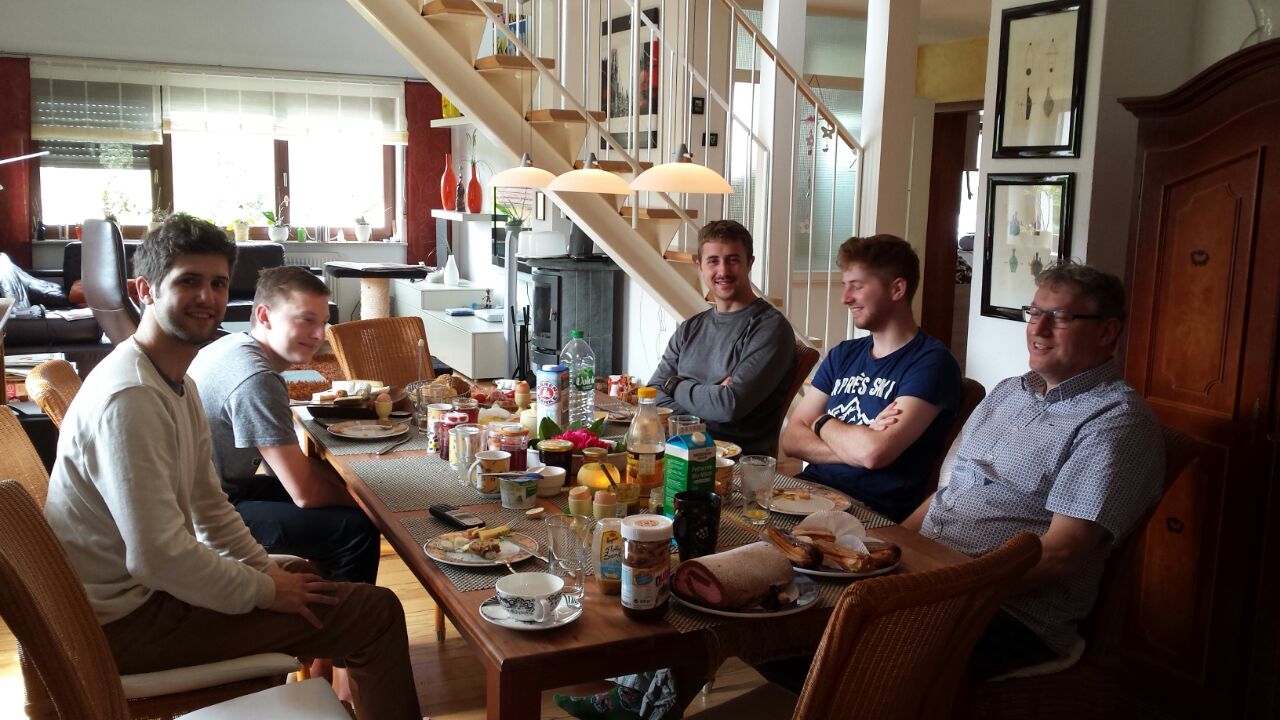
I mean, is it even Breakfast at this point?


We love cheese.
 

I took the brothers to the Bunker (from the old blog post) and this time it was open for visitors.  My Spanish friend Iago and Fabi also came.  It was a very serious experience and interesting for us.  I will copy and insert parts from the guide we were given with appropriate pictures.


"Of these 32 [B-Werke designated bunkers], B-Werk Besseringen is the only intact structure with all its armored cupolas left. The construction took 2 years (early 1938 to December 1939). As an important example of military technology, it was thus placed under a preservation order.

The B-Werke had always been considered "Top Secret" and therefore, unlike all other bunker complexes, were not disarmed during the war. [...]

The B Werk Besseringen was abandoned by the German soldiers on March 15th, 1945 without a fight. About three days later, the first American troops entered the B-Werk.

In 1997, the B-Werke Besseringen was uncovered [and is now maintained by the local heritage association]"

After the first page historical introduction, accompanied by the guide, we were asked to read the following passage:

"The Besseringen B-Werk is a historical building which was designed, constructed, and equipped solely for the war. Its size, weaponry and facilities and range of uses make it one of the largest installations of the Westwall.  Being part of an immense war machine, it was equipped with the most modern technology of the time. And in its role as a killing machine too it was designed to be highly effective.

The B-Werk serves to remind visitors of the lengths to which humanity was (and probably still is) prepared to go to apply its scientific knowledge, its skills and its whole economy to the waging of war.

But it should also remind visitors that the Nazi commanders of the B-Werk shared responsibility for the largest war the world has ever seen, with over 50 million dead.  In the German Wehrmacht alone over 2,000,000 soldiers died, with approx. 1,900,000 more missing and 4,400,000 wounded.

On top of those figures come the civilian victims of war: millions of men, women, and children.

And we can never forget the millions of people murdered during the war solely because of their race.

Over sixty years have passed since this barbaric war. Former enemies, particularly in Europe, have recognized the necessity for close cooperation at all levels, including military levels, to ensure that such a worldwide conflict can never again arise.

It is hoped that Europe will never again see the day when immense border fortress divide countries and peoples."


After reading the intro, we walked into the bunker.  The first stage was a room with trap doors and pifalls, and on to the decontamination chamber.  From there we passed through rooms towards the gun cupolas.


"Crew of 5, protected by an armored steel cupola. This cupola weighs about 51 tons, and the steel walls are 250mm thick [...]"


"This room was intended for 2 field-grade officers, hence the quality of the interior"


Not pictured: Flame Thrower Room.  It still had the original instructions for operation and smelled terrible.

"In 1946 an inhabitant of Besseringen was exploring the B-Werk. It seems he opened the armored door to the service room and looked inside with a burning match or light. This set off an explosion of the gases concentrated int he room. The explosion was so strong that the armored steel door was pushed towards the corridor. The damage around the door is still visible today. Traces of the detonation can still be seen on the soot-blackened ceiling in the hallway. The Besseringen citizen suffered fatal injuries."

Room 35:

"Room 35: Orderly Room?

Apart from the room for staff officers, this is the second room in the B-Werk facilities to feature an elaborate wall decoration.

The precise function of this room has not yet been established. [...] The theory that it is an orderly room is also supported by the more recent discovery of a slogan on the wall.  This little verse was discovered by [...] in the course of renovation work. It was most likely written in 1939/1940.

The rhyme was probably composed in the period when the bunker was first occupied, perhaps by a crew member or a soldier of the 79th infantry division [...].

The slogan is written in the form of a verse. At first glance the words appear to glorify the Nazi salute. But when the lines are examined more closely, a more critical and 'disrespectful' meaning emerges. For example, in the seventh line in the original German the phrasing suggests the writer did not necessarily regard the salute as very important. 

This interpretation could also explain why the jingle was later painted over.

Whatever meaning the rhyme may have had at the time, it remains a testament from the darkest chapter of German history"

From Exhibit:

"Not so loud with your Heil Hitler" there
roared out from an empty head
let me tell you good old mate,
you can drop the high salute,
and just as well say "hound dog" instead
If you choose to joke like that.
So if you want to say Heil Hitler,
Then do it truly, from the heart"

There were too many rooms to write about or show pictures.  Here is the last thing, from a Rest Room.

Fabian was walking and looked in the display, and his eyes immediately went to a little brown package that says "Only for the german Wehrmacht (army). Destroy immediately after use"


We asked the a docent, and he didn't know, but he found the head guy.  Apparently, the box contains a condom.  As part of the racial doctrine and army doctrine all soldiers were required to use them when in enemy land. It was so important that anyone leaving the bunker would have to show the commanding officer that they had one, just in case.  The guy went on to talk about just how insane the Wehrmacht was about things like this.

It was a heavy, but interesting, day.  We headed to the Volklingen Hutte direct from the bunker for an art show.

++++++++++++++++++++++++++++++++++++++++++++++++++++++++++++++++++++++
++++++++++++++++++++++++++++++++++++++++++++++++++++++++++++++++++++++
++++++++++++++++++++++++++++++++++++++++++++++++++++++++++++++++++++++
++++++++++++++++++++++++++++++++++++++++++++++++++++++++++++++++++++++
++++++++++++++++++++++++++++++++++++++++++++++++++++++++++++++++++++++

The old steel mill had an art exhibit that was really cool and integrated into the factory. It was called "Urban Art" and all about graffiti and street art.

Russell wasn't impressed yet:

Same artist who designed Obama's "Hope" campaign.


It was a cool mix of things that were shipped in, and things that were done on-site. Here is something Russell noticed on a beam as we were walking:


And on the walls outside:


Back to things inside:


Will is part of this installation:


This was cool- an artist took the giant poster advertisements and drew over them in paint:


And then more:


After walking around we explored the factory and had some age-appropriate fun:


We found the children's science exhibit, Russell was finally impressed:
Magnets!


Tuesday, June 16, 2015

Day 1 in Saar

THIS ISN'T SUMMER CAMP WAKE UP

Actually, it was full Pony Farm. Susi made a delicious breakfast:


And then we hit the road on our German horses:
 

First stop was to bike to the nearest Castle with a Biergarten:

We then took the ferry across the river:

I asked the Ferry Driver if we could go up to the overlook of the Saar. He said, "Ya, sure you can. It's harder with bikes." He then pointed me up a trail.

The trail ended up being so steep we had to push the bikes and max out the heart rate monitors on the fitbits. (side story Will's heart works the best / least often)

The Path led us to a beautiful path through somebody's farm:

I saw a farmer working on his tractor and went to go talk to him.  He was 100% Saarland and spoke in a very thick dialect.  Here is the impression I have of our conversation:

" Hello, I'm sorry to bother you "

"Hodi Ho NOOOO Problem I'm just working haha"

"We'd like to go to this place"

"It's down there far away around the corner behind the second tree and turn a couple more times and then you there which is far from this little old town"

"Okay thanks!" (It mostly made sense)

"SO where are you from?!"

"USA and I work-"

"HOOWDY HO HOWDY HAE HO HOwdy! I'm just a little farmer here on this little farm you can see I only have a few tractors (he gestures over his shoulder) but I'm sure you are used to bigger farms!!!"

"No it is very pretty here...."

Anyways we ended up talking a little bit and he was the jollies man I have ever met.  He also really helped us out.

Here is a beauty shot of his farm:

And then, as if it was meant to be, we passed a Pony Farm. I took a picture for Jochen.

After more riding around and exploring we ended back up in Kleinblittersdorf, where beers and grilling waited for us.


Heidelberg (almost) Reunion

     I'm super behind on the blog because a super number of things have happened this month. Mainly, Will and Russell visited.

    We decided to meet in Heidelberg as it is a cool town and between where I work, and the two airports Russell and Will flew into.  I told the host family and Jochen decided to come along and see a city he hadn't visited in awhile.  He was also kind and offered to drive us back.

Will got in to Heidelberg first, so I suggested he do that weird hike on the mountain I previously blogged about.  In order to meet our meeting time Will had to run from the top of the mountain down to the central square:


I was really suprised we were able to meet up, because we didn't have cell phones and my instructions were "meet at the church".  It turns out there are many churches in Heidelberg, but only one that catches a Beaumont's eye.  Will refilled on Crepe, and Fabi did as well:


I forgot to mention it: Russell's plane was delayed and his phone wasn't working.  So we knew he was late, but had no idea when or if he'd ever show up in Heidelberg.  Our emergency plan was to meet at McDonalds late at night... we trusted that would hold.  Pretty view:


Per appropriate brother-code, Will and I held a meeting and unanimously voted to kick Russell out of the trio and induct Fabian.  He was ecstatic:


Jochen confessed that when Fabian was younger he almost sent him to a boarding school in Heidelberg.  It was nice to be there as Fabi tried to piece together what that meant.  After all the talk of correctional education programs, we decided to visit the historic and semi-ancient Heidelberg student prison:


"From the time of its foundation, Heidelberg University exercised legal jurisdiction over its students.    [...] Punishment usually took the form of confinement in the University jail for a period ranging from 24 hours to 4 weeks.  As the 19th century progressed, 'doing time' in the Student Prison (Karzer) became less and less onerous; indeed, it became something of a matter of honour for most students to have experienced at least one stint of prison life while studying in Heidelberg.  The most common offences included disturbing the peace at night by loud singing in the city lanes, inappropriate behaviour in public as a result of inebriation, and participation in illegal fencing duels. Budding academics seemingly had a particular foible for nocturnal raids aimed at releasing the pigs and piglets penned up in the Old City and then driving the squealing animals through the streets.  Students could easily end up in the Karzer if they insulted a uniformed local constable (called an Amtmann in those days) proudly walking his beat.  Those unwise enough to knock his cap off with a stick or to enjoy a good laugh at his expense soon found themselves behind bars.  Such misdeeds were considered to amount to obstructing a police officer during the course of his duty and were punished with 4 weeks of incarceration.

[...] On the first 2 days of confinement, prisoners were given only bread and water.  After this, students could have food brought in from outside, and even beer, if they so desired.  The cells were provided with hard beds with straw mattresses.  Internees had to pay for the use of pillows, covers and sheets, or bring their own.  The only other furniture comprised a couple of tables and stools. While 'inside', the students whiled away the time by playing cards, and many carved their names on tables. They could freely visit fellow-convicts in neighbouring cells and even use a connecting door to enter the University to attend lectures.  However, they were forbidden to leave the building.  The detainees spent much of their time decorating the prison's stairway as well as the walls and ceilings of their cells.  [...] For black 'paint', they used candle-smuts or soot from the fireplace.  As time went on, they brought paints in with them.  [...]  The students' names for the various rooms included Solitude, Palais Royale and Sanssouci.  The 'King's Throne' was the fanciful name of the smallest and most private room in the prison."


- from the placard at the prison. but I was lazy and searched google and found the above text from: "http://moonbots.mcleanrobotics.org/"


The students' grafitti was pretty hilarious.  We found drawings and poems from before 1889.  A classic and reoccurring theme was something along the lines of: "Dear sweet ______ the nights are cold and I long for your warmth" etc. etc. etc.

We then decided to walk into the church nearby, where somebody happened to be practicing the organ!

 This was the beginning of Will's lucky streak of only visiting churches while the organs were playing (4 for 4 in the Saarland area).


We decided to stop stalling and go to the Castle... we had given up on waiting on Russell.

And then right about here:

I received a call from Russell.  He was stuck in a crazy mess caused by the previous week's train strikes and a kind German had taken pity on him.  Russell received advice and a free phone call, but the end result was that he wouldn't make it to Heidelberg for a few more hours.

Castle, with the replacement and Will:

Jochen wonders how many photos are actually necessary:

There is something mesmerizing about this tree.  I took a ton of photos of it last time and couldn't stop myself on my second visit:

The hill behind the tree is the mountain Will ran down with his suitcase over his shoulders.  He claims to have yelled "Bear" the whole time so other hikers wouldn't think he was crazy.  Here Jochen and Will try to quantify how crazy a running tourist in normal clothes with a suitcase must have looked.

Russell missed a delicious dinner but finally arrived.  In keeping with code, Fabi was demoted back to his original surname:

The greatest part was when the guy who helped Russell called us to follow up and make sure that Russell made it.  He was genuinely concerned about the train system and that they would ruin our European Reunion.

Random Saarbruecken


An old picture of the bridge over the Saar and St. Johann the church.  St. Johann is where my train stop is and the castle is where will and I will visit in future blog posts.


A coworker and friend helped me make the bike real nice for Will.  Replaced the entire drivetrain:


Went on a field trip to a mechatronics research center in Saarbruecken. Mechatronics is automation and sensor feedback.  We were there for work because they have a super high tech laser for welding that our firm needed to use:

It takes readings of reflectivity, light intensity, temperature, speed, etc. and constantly adjusts welding parameters to ensure a perfect laser weld is made.

My boss liked the table and used his smart phone to measure the hole sizes:

His phone is "smart" because it knows someone his age only needs to buttons (M1 and M2): a button to call the wife and a button to call the business. He's a jokester.