Sunday, February 15, 2015

Konstruktion eines Rotorblattes für vertikale Windturbinen

 I finished working in the Wind Lab part time.  It was a fun experience- I made great friends and learned.

After I gave a final presentation explaining what I did, I was gifted an awesome (custom) mug from the professor in charge.  I really enjoyed working in the lab and learning what I did- it was a cool experience and everybody benefited!

Saturday, February 14, 2015

How does the internet work?

Dear Reader,

Who are you?

I always assumed you were my Grandparents, or my parents, and sometimes a bored sibling.  Maybe on occasion someone that one of the people above decided to share this with.

But the numbers say otherwise.

Blogger has an interesting 'web-traffic' function I just discovered. Here is the summary of interesting info:


I added some comments, in an attempt to help myself sort this out.  But, ultimately, I don't think it can.

I hope everyone enjoys this blog and isn't doing anything nefarious.

Sincerely,

The Author

Heidelberg Castle

http://www.journeymart.com/de/AttrationImages/heidelberg-castle-heidelberg.jpg
We visited the 700 year old castle, which has more or less been in a state of partial ruin since the 18th century. Lightning bolts, mines, and neglect have left the town with a beautiful ruin, which I was going to describe, until I read Mark Twain's description on Wikipedia: 

"A ruin must be rightly situated, to be effective. This one could not have been better placed. It stands upon a commanding elevation, it is buried in green woods, there is no level ground about it, but, on the contrary, there are wooded terraces upon terraces, and one looks down through shining leaves into profound chasms and abysses where twilight reigns and the sun cannot intrude. Nature knows how to garnish a ruin to get the best effect. One of these old towers is split down the middle, and one half has tumbled aside. It tumbled in such a way as to establish itself in a picturesque attitude. Then all it lacked was a fitting drapery, and Nature has furnished that; she has robed the rugged mass in flowers and verdure, and made it a charm to the eye. The standing half exposes its arched and cavernous rooms to you, like open, toothless mouths; there, too, the vines and flowers have done their work of grace. The rear portion of the tower has not been neglected, either, but is clothed with a clinging garment of polished ivy which hides the wounds and stains of time. Even the top is not left bare, but is crowned with a flourishing group of trees & shrubs. Misfortune has done for this old tower what it has done for the human character sometimes – improved it." -Mark Twain


Among other fun things, the castle has the largest barrel I have ever seen in my life.  "The Great Barrel" is around 22 feet in diameter and 30 feet long, holding about 500,000 lbs of liquid (estimate based on claimed 228,000 liter capacity).  The first excessively large Heidelberg barrel was built around 1600 at about half of that capacity.  After 3 failed designs and extenuating circumstances, the final barrel (which we got to see) was built in the mid 18th century.


 We walked round the castle for awhile:


Not sure if Kyndall or Vanna White...

Coolest sundial ever:


The German Pharmacy Museum is also located within the castle.  Germany was big in the creation of regulated pharmacy- the museum was well done enough as to make this topic interesting.


We decided to take a tour of the inside of the castle once it was too late- the last tour had already left and newcomers weren't allowed.  Next time!

Thingstätte Hike, Heidelberg

We went on a day trip to Heidelberg, which has one of the most quaint German 'old towns'.

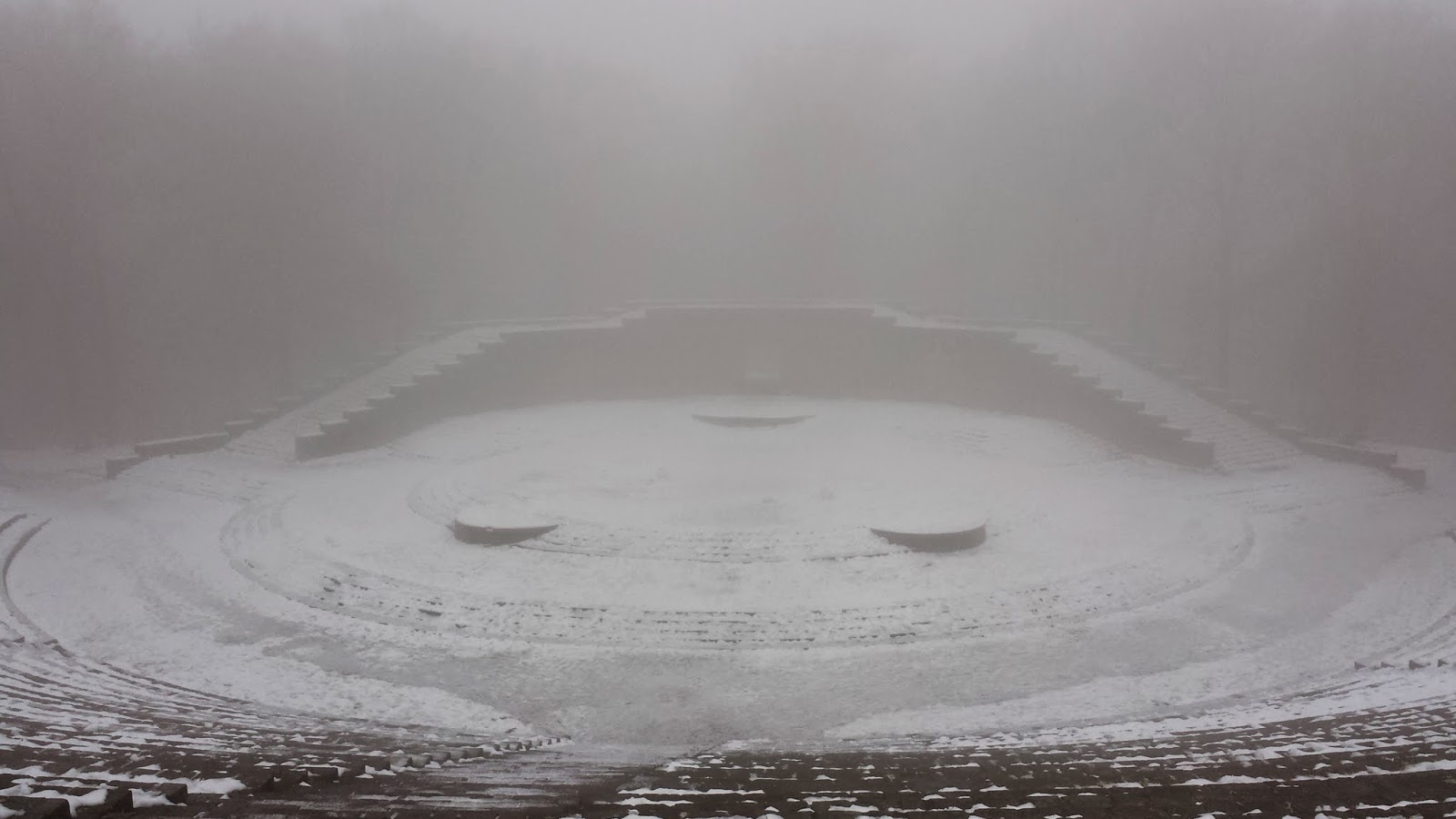
Our first step was to hike to Thingstätte, a giant outdoor amphitheater built by the NS on top of the mountain near the city.  The path to the amphitheater takes you along 'philosophers way,' named such by the shear number of famous thinkers that lived in this part of Heidelberg and frequented these woods for walks. 


From lookout 1:

The hike was longer, snowier, and colder than I predicted...


But we eventually made it:


With all of the snow and fog -and no other visitors- it was a creepy place.  It was built for NS Youth rallies and for public displays of culture (operas, plays, choirs, etc.) right before the war broke out.  Knowing its history definitely affected the way we experienced the architecture, which objectively, was very beautiful and connected with the scenery.

We walked from the theater to visit an old monastery / ruins of a castle but came up short- the gate was locked.  The top of Heiligenberg was home to the monastery over a thousand years ago- it seemed like it would of been cool.


On the way back down we found the Bismark Tower, a tribute to Otto Von Bismark.  We climbed to the top and got to see a beautiful view of Heidelberg across the river.


Voelklinger Huette

One day I convinced Lena, Fabian, and Kyndall to go to Völklinger Hütte with me.  Völklinger Hütte is a historic iron works that has become a UNESCO World Cultural Heritage Site.  The giant foundry and mill began in the late 19th century and was operated for around a 100 years.  When the company went bankrupt, the community decided to convert the facility into an interactive museum on iron and to convert part of the facility into a museum.

First we went to the exhibit on Egypt.  The coolest part of the exhibit was a giant timeline from the beginning of civilization to the present, with different civilizations and their reigns marked.  It put into perspective how relatively short 'AD' is and how long the Egyptian empire lasted, especially compared to other 'great' empires such as the Greeks, Romans, or Aztecs.  

The museum space is located in the 'blower hall' of the iron works.  This hall generated the compressed air to feed the fires of the crucibles.  The exhibits were placed all around the old equipment of this hall, which had been cleaned and cut open so you could see what the machines did and how they worked.  My interest was split between Egypt and some of the massive pump fly-wheels or compressors...
http://www.voelklinger-huette.org/typo3temp/pics/370fa00d00.jpg
This is a shot from a different museum exhibit, but you can see how everything is worked into the industrial setting.
http://www.urlaub-und-reise-news.de/images/news/13074_news-2014-01-Weltkulturerbe-Voelklinger-Huette-Pop_Panorama_Merkel.jpg
After Egypt, we went to go see the Iron Works museum itself.  The museum was almost completely empty (Tuesday 9am) and completely open to explore.  We got lost a few times in random sections of the massive plant because it was so large, open ended, and devoid of workers.


It was really cold...


Everybody was excited to see industrial manufacturing...


And happy to take photos for their parents...


We wanted to pull an 'Indiana Jones'...


Those two mountains are actually part of the waste of turning ore into Iron...


Saarbruecken Around

     A part of the Camino de Santiago de Compostella (one of many) goes through fields near Kleinblittersdorf.  In German, this is called Jakobsweg (St. Jacobs Way).  We went for a walk to see the path and some of the countryside.


With my Student ID, I get free tickets to any event at the Staatstheater.  Kyndall and I went to go see Tosca.  Tosca is a Puccini opera (in Italian) about a love between a painter and a beautiful woman which is tested and tortured by the circumstances of their time.  Kyndall and I enjoyed the play (singers were great!) but struggled to make out the storyline between the Italian singing, and French and German subtitles.  The theater was very small and beautiful.  This is the aforementioned theater from a previous blog post that was gifted to Saarland by Hitler and the NS party.


Nobody escapes Dance Dance Revolution when they visit the house.  Highlight was Kyndall and Lena's Bollywood dance-off.

We were also shown the Kings Cake tradition on Jan. 6th.  There was a lot of suspicion that Lena didn't win on luck alone...

One day we took Lena to the orthodontist.  In the waiting room we found the waiting-room-game to end all games: Perplexus Epic. 


Watch the video for around 5 seconds and you get the idea:


I'm not sure what age range this is for, but once I figure out, I'm gifting it to all of the cousin-babies when the time comes.

Another night we went to eat in a restaurant with a seating capacity of 200; we were the only ones there.

Kydall learned how fun waiting for mass transit is:

We also went to my favorite 3 euro Rigatoni place.  Rigatoni is very popular in Saarbruecken for some weird reason.

In honor of Kyndall leaving and the parents being out of town, Fabian, Kyndall, and I cooked the most amazing stuffed burgers.  The secret is to add onion-soup mix and chopped vegetables to the meat when you form the patties.

Saturday, February 7, 2015

Day of Culture

Kyndall and I decided to blitz the Notre Dame for 7am church service, which meant we woke up early.  Breakfast was excitin- I prepped for an attempt at French using my dictionary that morning.  I felt somewhat accomplished, although I didn't mean to order thinly sliced pieces of meat nor a child sized coffee.  I was in high spirits until the food came and I learned that instead of "good morning" I had been saying "good evening".  I thought the waitress' laugh was because I was so surprisingly fluent:
 

From the Notre Dame we went to the St. Chapelle, which was the best church of Europe in my opinon.  St. Chapelle was the personal church of King Louis IX and once held the Crown of Thorns and other relics.  King Louis (later Saint Louis) could enter the chapel directly from his royal living corridors, which were attached to the chapel by a second story fly-over.

The stained glass was stunning:


From the Chapelle we went to the Musee d'Orsay:

The museum is in an old train station and is dedicated to impressionism. In Paris, wherever we were, it felt like I was walking through my old history books- I saw first hand a lot of the art that my old textbooks included.  It was a surreal.

Cool bits:

They had a dedicated exhibit to Marquis de Sade, who was one weiiirrrdd dude.  His writings and philosophy is what "sadism" or "sadistic" comes from.  The exhibit had crazy quotes of his along the walls and then displayed art that was influenced by his philosophy and life.  He was quite the rebel and anti-establishment, which people attribute to inspiring art that broke some long standing artistic traditions.

They had art from original set-designs for the Parisian Opera.  The set-designs were intricately painted oils on cut-boards that were put together to form a 3d diorama of the conceived set.  We liked this a lot.

There was an exhibit on Militant Catholic Art which was also really interesting.  For a time, France was extremely Catholic and commissioned lots of religious works that were meant to convey the power and splendor of the church/religion.  The exhibit had all of the sketches leading up to the final products (sometimes murals, paintings, or sculptures) and explained what decisions and symbolism influenced the final piece.

They also had an exhibit on the artist who did most of the work for the Sacred Heart Basilica.  It was interesting seeing his studies for the perspective mural of Jesus on the dome.

We were there forever, we got very tired:


They had a cafe that was very essential. I won't tell you how much the espresso was, but know it was worth it because it allowed us to keep on exploring the collection.

 Overview of the main room of the collection.  Can you imagine all of the trains?

Afterwards we went for a walk.  I spotted my next target, the Grand Palace (Gran Palais):