Saturday, May 9, 2015

Hexennacht, Maibaum, and Maiwanderung

April 30th is Witches' Night in Germany: Hexennacht.  During the night all of the witches get together and party because they are excited for the coming of spring. Or, youth go out on this night and play tons of pranks:

Hexennacht seems to be a sweet spot of nostalgia for many older Germans here in Saarland.  They speak of it the way many parents recall to their children "walking both ways uphill to school everyday- in the snow."  It would seem that the younger generation is lazier and less creative, resorting to base pranks like toilet papering, shaving creaming, and destroying property.  When adults were kids they did clever things like:
- Brick and mortar the door of their grandparent's front door shut
- disassemble a tractor and put it on the roof of a barn
- pick up cars parked on the street and move them sideways into the middle of the road
- cut all of the flower blooms off from a neighbor

People at work and around the house shared plenty of other great stories from the "golden years."

May 1st is Maibaum (May Tree/pole) day.  The entire village gathered at 11am in the rain in order to watch the pole get put up by the fire department:


Because Germany loves traditions, there was a band and a few speeches from prominent villagers. And, it is never to early for a beer:


It was rainy and slippery, and the pole looked really heavy.  So like any terrible person, I thought, "I should film this":


I took out the sound because my German is terrible, but at one point we start asking aloud "why are they standing under it?" and "should we tell them to stop?" and "is this going to be the tragic day we lost our entire fire department?"

Along the pole are the "coat of arms" from prominent clubs and businesses within the greater village area. The pole stays up until October or so.
 

After the Maibaum, I took part in another May tradition: Maiwanderung (May hike).  I believe the idea is to welcome spring weather with a hike, beer and grilling.  I was invited to an outing with the Uni, but it fell out due to the rain.  I tagged along with Fabi and his friends instead.

As tradition requires, we filled a wagon with beer, grabbed a boombox, and went wandering.  We stopped once and had our picnic and played a German drinking game that involves bowling- it was pretty fun.

Here is a time-lapse we made together for his friends:


Unfortunately the wagon gave up on the last stretch home, so we were forced to carry it.  All things considered, I give this tradition a 9 out of 10 and think it should find its way across the pond. 

Sundaytrip

   The next day I was invited by a friend to check out a few spots along the Saar, including the Saarschleife, but this time from the correct side!  The Saarschleife means the "bow" of the river due to how quickly it turns.

The visitors center was very new and pretty.


 And the view was even prettier:


Right at the highest part in the middle you can see the castle from yesterday's bike outing.

And here is a picture of the crew, minus the boyfriend, who had to be photographer:

I also worked on pioneering Selfie technology:


From the Schleife we went to Trier, an old roman city.


Here is La Porte Negra from ancient Roman times.


The best part of Trier were the two beautiful churches.  Both are Baroque style, which was refreshing to see, especially because I hadn't seen this style before.

 The first, the Cathedral of Trier, rivals the Koelner Dom in size.  It is the oldest Bishop's Church in Germany. Apparently 'Cathedra' means seat of the bishop in Latin.

I'll paraphrase some of the brochures I read and bought from here on out:

-Legend has it that the mother of Constantine, the Roman Emperor, gave her house to the church in the 3rd century in order to build a church (ruins of a house found under church).
-The first church on the site dates to around 313 AD; the main walls of the church as I saw it were built around 340.
-5th century Germanic invasions destroy most of the church
-9th century the vikings destroy the rebuilt church
-11th century restored and vaulted ceilings built
-13th century the Church of Our Lady is built (the second church I will refer to)
-17th century, the church is remodeled in Barque style at the end of the 30 years war
-1702-08 the Holy Robe Chapel is built to house the seamless tunic of Christ (more on this later)
-1960-1974 fully restored, church is consecrated and Cathedral open again
- 1986 UNESCO World Cultural Heritage sight

 Garden of the Cloister:

I was captivated by this part of the ceiling:


Apparently the clock says, "you do not know when the lord is coming" above it, in latin.


So I didn't take any pictures from the Chapel of the Holy Robe, but it was pretty crazy.  There were jewels and gold and beautiful stone work surrounding a giant sealed glass case, which had the chest containing the robe inside.  Tradition has it that Constantine's mother brought the seamless robe of Christ to Trier, although it is first mentioned in the 11th century, and only officially documented during the 12th century.  Beginning in 1513 the chest was opened on occasion for pilgrims (between 1513 and 1996 it was opened 16 times).

Starting in 1996 the chapel of the robe became accessible during the Holy Robe days, which was why I was able to see the chest (I think, signs and websites not entirely clear).  Unfortunately, it the last time the robe was on display was 2012, and due to concerns about preservation, it isn't planned on being opened in the near future.  Apparently at one time it was dipped in rubber, in the thought that it would help preserve it (bad idea).  The authenticity of the robe is unknown, even within the church, but it remains important as a "symbol of the undivided christian church and [...] of the binding power of God".


From the Cathedral we went to the Basilica of Our Lady:

This was built by french architects in the 13th century and is technically "high-Gothic" in style. I should of taken an architecture class and not music appreciation- if only I'd known!


The church is extremely colorful and everything stands out on the white stone.  Its motto, poorly translated by me, goes "Let the rose bloom again", because it was recently restored to it's full splendor.

It also had a beautiful ceiling:


Here are the gardens, I believe, of old Constantine's Palace.  Behind the building pictured is apparently part of his residence (which can still be visited- we didn't).


After Trier, we went to Saarburg for dinner.  We climbed to the top of the fort, a relic of Luxembourger rule in the area.

 The Mosel and the Saar are known for their wine:

And for being particularly beautiful:


We then went to the town center for some pizza and a taste of the local wine:


The weather and town were very nice to us.


It was a great trip!

Friday, May 1, 2015

Fahrt Nach Merzig

*** Tip: the hyperlinks (Blue underlined words) are to something related to the post. If you don't feel like reading in German, you can "right-click" and translate page to English, on most browsers***


Some friends and I decided to ride down the Saar in order to check out a few "Famous" places in Saarland.  We stopped first at Werner Freund Wolfspark- a private reserve for wolves.  The camera worked for this portion of the trip and I made the following video:

----WARNING: If you have epilepsy, I'm not sure this will help.  You can slow down the speed if you open the video on youtube ---- 


I've never made a video before, so this was more of the learning step. In the future I'll try to take photos more often so it is smoother.

Here is our Nutella cookie break:


And finally at the Wolfpark:

The wolves were all pretty tired but luckily napping close to the fence:


As we were leaving the park we realized someone had a nasty flat caused by a ripped tire.  Unfortunately he was forced to walk the bike to the nearest trains station and go home.  The remaining two of us pushed on.

As we were riding I saw this colossal cement structure and decided to check it out:


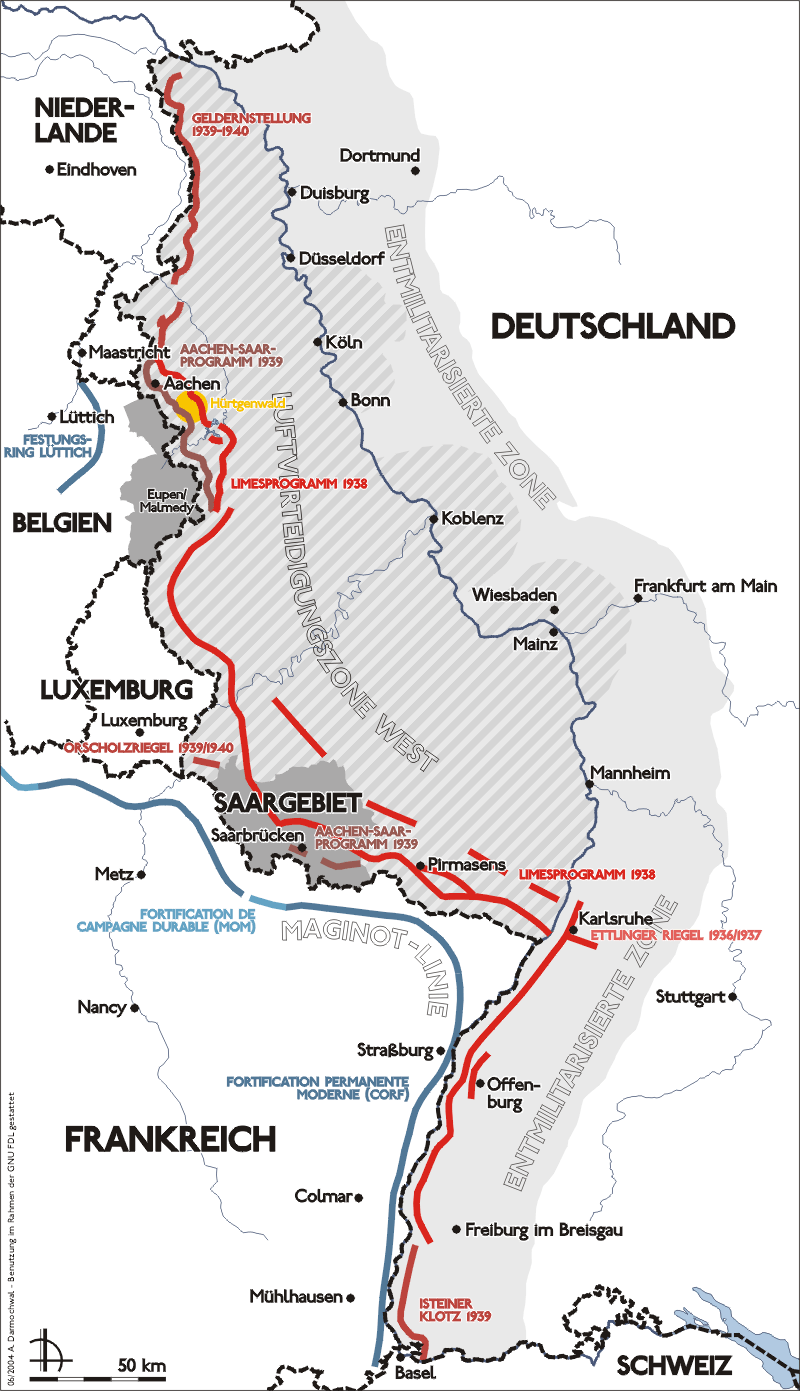
     It turns out (luckily there was a sign) that building was actually one of the 14,000 bunkers (B-Werk) that comprised of the "West Wall."  The West Wall stretched from the eastern French border all the way to the North Sea and was meant to protect German land in the event of a war.
CC BY-SA 2.0 de (http://creativecommons.org/licenses/by-sa/2.0/de/deed.en)], via Wikimedia Commons
     The French counterpart, the Maginot Line, was built just a long the French-German border.  The French army, at the time, needed several weeks to mobilize.  They believed that the Mignot Line would allow a small group of permanent servicemen to repel the Germans until their army was ready (in the event of war).  They also counted on the Germans to respect Belgium's neutrality, so the line of forts didn't extend along this border.  The German's violated the neutrality and invaded France through Belgium, meaning the government spent millions of dollars for nothing.  It's hard to imagine what the state of affairs was in the region during the 1930s.


The bunker extends 4 stories into the ground, has 44 rooms, and was staffed by around 80 people.  The idea was that this bunker would protect a vital crossing and allow a small group of men to fight for over 4 weeks alone, in the event of an invasion.  You can see the view of the Saar valley from the roof, as well as the observation and gun cupolas:


It was unclear from the sign and from a short search on the internet, but it seems more than likely that this location participated in the fighting against the American troops during the Rhineland-Palatinate fighting.  I think I'll look for a book on area history- it's still hard for me to believe so many terrible things took place here in the last century.  It was pretty sobering to walk around the sight and think about it's individual purpose and role in history.


After we got back on our bikes and pedaled our way back to happy thoughts, we stopped for this beautiful view:

We also happened to be lost- we weren't too upset.


Eventually we made it to the Saarschleife (more on it later) and rode straight up the mountain to an old castle. Burg Mountclair was built sometime in the 12th century due to it's strategic position on the Saar (mountain top, surrounded on 3 sides by water), but it has been used as a strategic position since the 3rd century (think Romans, Germanic tribes, and Celtics).


Inside the fort was a pretty cool musuem, but an even cooler Biergarten:

Riding bikes can make you thirsty. While we were waiting for our beer, I couldn't help but notice a young knight honing his sword in the corner.  I decided to test my German and investigate if he was the victim of timewarp.

Despite his garb and collection of weaponry, he was surprisingly from a nearby village and had a job.  His real love in life, however, was middle-aged history and weaponry.  Him and his club role-play almost every weekend when the weather is good in order to have fun, provide entertainment for visitors, and talk about their hobby.  He was a super nice guy and told me all about his replica weapons and how each one was special in its own way.

He even showed me how balanced his long sword was.  "But How!?" you ask? By gently commanding me to "Bleib ruhig" and then throwing his whole torso into a arcing swing of his sword... with the blade stopping 5-10cm from my neck.  In my surprise, I reflexively said some colorful, polite phrase in English- which led to a few questions about where I'm from.  We enjoyed our short talk but were interrupted by the delivery of some needy beer.

Fast forward 20 minutes... our snack is interrupted by the sweet, singing sound of the war-maker's symphony.  We run up the tower investigate:


No! our knight!  He's too young to die! He's losing footing to the overhead blows of the weisser Ritter.


But Oh! how he channeled the primal energy of his mane and fought the lesser man (seen in white with the unsightly unsightly 21st century haircut).  The fighting was relentless! **Except for the 2 minute break when they were out of breath and accidentally hit each other**


During the water break We got to look at half of the Saarschleife:

Once we were fully relaxed, entertained, and replenished, we hit the trail.  Mettlach:


Home of Villeroy and Boch, world-famous Porcelain makers.  Here is the estate:


And one of the many office buildings.


We were pretty tired at this point and decided to take the train home: